


Leading Through AI Disruption: MDB on Adopting AI Responsibly
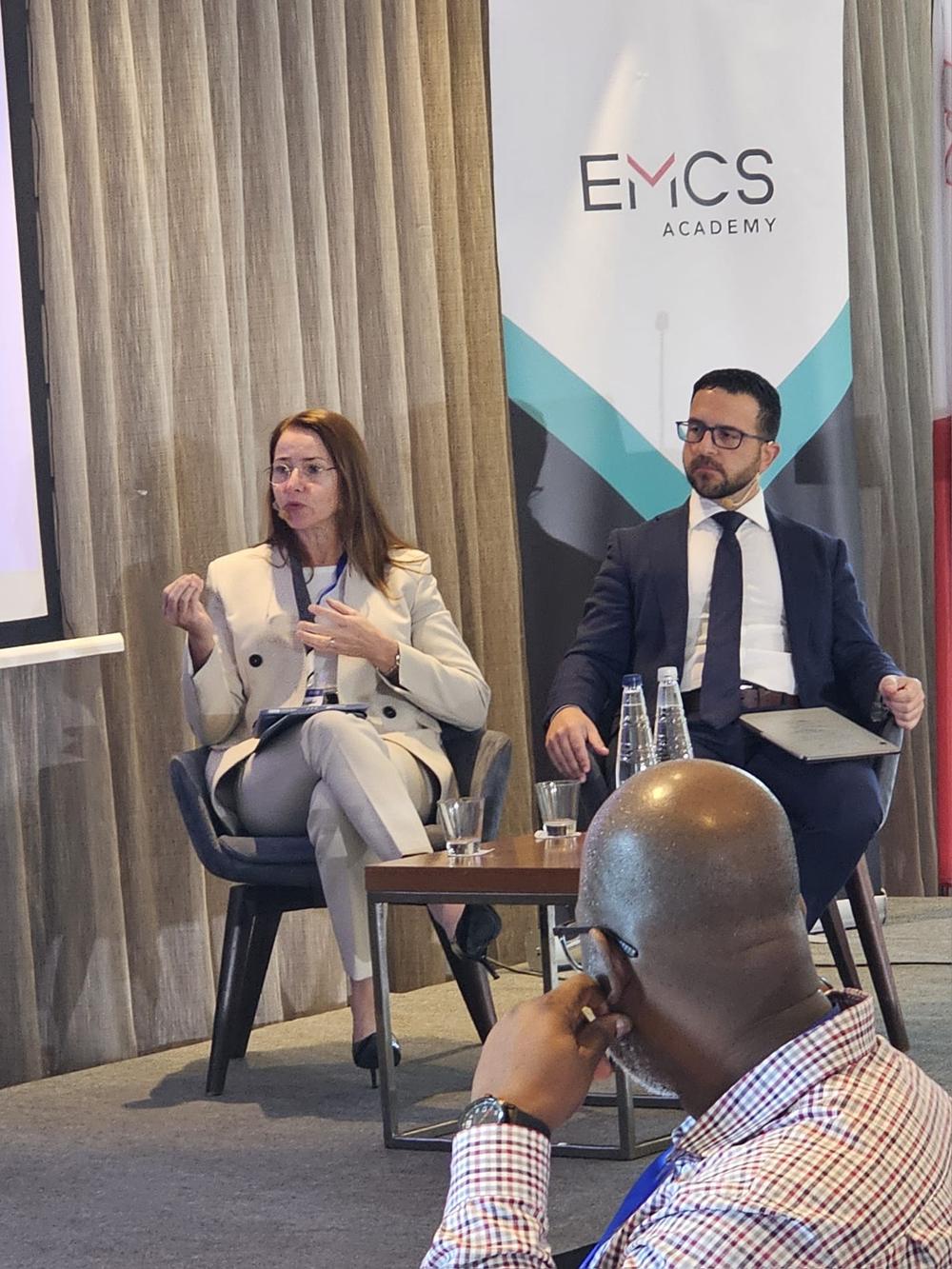
Malta Development Bank (MDB) took part in the panel discussion at Leading Through AI Disruption, a seminar organised by EMCS Academy in collaboration with Digital Brain, where MDB’s CEO, Alison Micallef, was a panellist. The discussions looked at how leaders embed AI in their organisations, prepare their people, keep strategy and operations aligned and judge whether the technology delivers. MDB’s contribution drew on the principles that guide its work as Malta’s national promotional bank: investment should address a genuine need, rest on a credible rationale and produce sustainable value.
Ms Micallef was joined on the panel by Prof. Alexiei Dingli, Professor of Artificial Intelligence at the University of Malta and Director of Digital Brain; Mr Jonathan Gerada, Chief Artificial Intelligence Officer of the Malta Public Service, who opened the seminar with a keynote on AI governance and Malta’s vision; and Dr Paul Daniel Micallef, Managing Director of Mindworks Malta Ltd. The sessions were moderated by Julian Douglas, CEO of The CX Academy in the United Kingdom.
Starting with the problem
Asked what separates an AI initiative that is adopted from one that is genuinely embedded, Ms Micallef said the difference lies in whether AI remains a technology project or becomes part of how the organisation works. An organisation can purchase a system, train its people on it and call that adoption, she observed, whereas embedding AI means connecting the technology to a genuine organisational need, building it into existing workflows, supporting the people who use it and measuring it against a clear outcome.
In her view leadership has to start with the problem and ask what the organisation wants to improve, whether that is productivity, service quality, decision-making, risk management or the customer experience. She added that someone needs to be accountable for the business outcome as well as for delivering the technology. Ms Micallef drew a parallel with MDB’s investment decisions, where the questions are whether a viable and productive investment stands behind a proposal, whether it meets a genuine need and whether it produces sustainable value.
Readiness and the role of people
On readiness, Ms Micallef said the work begins well before procurement. Leaders need to know whether the organisation has the right data, processes, skills, governance and management capacity, and she cautioned that there is little value in automating a process that is already unclear or inefficient.
She stressed that the workforce needs to be considered just as early, with employees understanding why AI is being introduced, what will change, what will stay the same and what reskilling support will be available. Ms Micallef saw an important role for unions and employee representatives here: where AI may affect roles, responsibilities, work organisation or skills requirements, dialogue should take place early, before decisions have effectively been made, so that legitimate concerns can be identified, implementation improved and trust built.
Leadership behaviours
Ms Micallef highlighted four leadership behaviours for keeping strategic discipline and workforce engagement in balance: clarity, openness, discipline and humility.
Clarity, she explained, means setting out what the organisation is trying to achieve and where AI fits into that strategy. Openness means being transparent about uncertainty, since leaders do not need to pretend that every consequence of AI is already known, and she noted that acknowledging what is still being learned builds more trust than presenting technology as a predetermined solution. Discipline means being ready to say no to initiatives that do not solve a meaningful problem or cannot demonstrate sufficient value. On humility, she pointed out that the people who work with a process every day often understand the impact of a proposed system best, and that leadership has to create space for that knowledge to shape implementation.
Lessons across the public and private sectors
Asked what the public and private sectors can learn from each other, Ms Micallef said there is value in both approaches. She described the private sector as often strong in experimentation, speed, customer focus and linking investment to measurable outcomes, and suggested that public organisations can learn from its willingness to test smaller applications, learn quickly and scale what works instead of designing everything centrally from the outset.
The public sector, she said, brings accountability, transparency, proportionality, fairness and careful stewardship of resources, and these principles matter most when AI begins to influence decisions that affect people. Private organisations can adopt the public-sector instinct to ask whether something should be done as well as whether it can be done, who remains accountable and how decisions can be explained. Ms Micallef felt the strongest model lies somewhere between the two, with enough agility to innovate and enough governance to keep innovation accountable and aligned with the organisation’s purpose.
She pointed to development banking as a familiar example of this balance. MDB exists to help close financing gaps and enable productive investment, and it still applies viability, eligibility, credit and risk requirements. In her view innovation and discipline should reinforce each other.
Alignment, ownership and measuring results
On alignment, Ms Micallef said leaders should start with one shared outcome. When strategy, IT, HR and operations each see AI through their own lens, fragmentation begins at once, so the objective needs to be expressed in terms everybody understands: what problem is being solved, for whom, and how the organisation will know it has improved. Each function then makes a defined contribution. Technology considers secure and reliable delivery, operations tests whether it works in practice, HR looks at skills and organisational impact, finance examines cost and value, risk and governance functions consider controls and accountability, and customer-facing teams ask whether the service is better for the person using it. She emphasised that these questions should be answered together.
To avoid fragmentation, Ms Micallef recommended a cross-functional governance structure in which every initiative has one clearly identified business owner. She suggested a common framework in which each proposal answers the same questions: what problem it solves, what data it needs, what benefit is expected, what the risks are, what skills are required, who is accountable and how success will be measured. Visibility over the whole portfolio of initiatives, she added, helps an organisation avoid overlapping tools, differing standards and the same problem being solved several times. Ms Micallef said AI governance should not sit solely with IT, because AI affects investment decisions, people, risk, operations, governance and customers.
How MDB supports digital and AI investment
Does MDB finance digital and AI projects?
Digital innovation is one of MDB’s focus areas, alongside the green transition and support for SMEs and infrastructure. As Ms Micallef noted at the seminar, the Bank exists to help close financing gaps and enable productive investment, and it applies viability, eligibility, credit and risk requirements to proposals.
Is there support for innovative start-ups?
MDB and Xjenza Malta have introduced the Go-To-Market Loan Assistance Programme for innovative Maltese start-ups that already take part in Xjenza Malta initiatives. MDB provides an 80 per cent guarantee on loans issued by participating banks, and Xjenza Malta offers grant support that includes an interest rate subsidy and help with upfront bank contributions and collateral.
How does MDB work with other European institutions on digital financing?
MDB has hosted a technical workshop with the European Association of Guarantee Institutions (AECM) that brought together 20 European guarantee institutions and promotional banks. The discussion covered how to assess the risks of emerging technologies and how to tailor financial instruments to digital ventures.